Ruprecht von Kaufmann
Alexandra Etienne
Headline: Serendipity, Re-Imagined ; Visual Suspense in Charcoal ; Serendipity Unfolds ; Chance and Time in Charcoal
Intro: Ruprecht von Kaufmann’s paintings, drawings and mixed media sculptures are filled with suspense and clues that spark and fire up your imagination. When I met the artist at the opening of his solo show at Kristin Hjellegjerde Gallery, our stimulating conversation zoomed in on his practice through the lens of this arresting exhibition and the meaning of ‘chance’ in art, a must-see.
Excerpt: Munich-born, L.A trained and Berlin-based artist Ruprecht von Kaufmann is known for the rich tapestry of meanings in his work [where time is hinted at from within: sketched lines, sub-hues make visible how the work had evolved before we see it in the flesh]
When the moon is a cold chiselled dagger
Ruprecht’s charcoal drawings are like the first few lines of a poem or a song that lets our eyes and minds wander and our imaginations fill the scene. They draw you in because they hint at something words cannot express, somewhere intangible, in-between spaces of mystery and enigma that we can’t quite pinpoint but still are part of our lives: déjà-vu sensations, chance encounters: serendipity. Inspired by the Persian tale that gave this exhibition its title “The Three Princes of Serendip”, this series is a palimpsest of its own and an ode to the line, how it can conjure a silhouette, a gesture, a movement with such economy of means. Less is so much more.
Ruprecht von Kaufmann takes us on visual journeys of the mind, unraveling threads of time that our interpretations can reconnect.
These drawings stop you in your tracks. The surface of the paper lays bare time itself: the shreds and holes and layered lines and sub-hues disclose how each drawing came into being as it changed over time inside the artist’s studio. One line or hue leads on to the next in unexpected ways, like ricochets. Serendipity here is imbedded in the creative process, chance encounters of charcoal with the paper as the work takes on a world of its own for us to marvel at. The surprise effect lives on as we look into these works, into their depth and nuances: The Three Princes of Serendip is a must-see show, on view at Kristin Hjellegjerde until the 22nd of February 2020.
Literature, Chinese calligraphy, body language were some of the ideas we touched on when I met the artist at the opening. Now for further insights into his practice:
1. Space, air, fire, water, earth… which of these elements would you choose in relation to your practice and / or your self, and why?
A curious choice here: space doesn’t seem to fit this alchemistic understanding of the four elements. But actually space is the one I would choose as it plays a pivotal role in my work.
The emotional impact of my work, the instant sense of empathy it can create is crucial for me. That to a large extent is generated through spatial arrangements, or how figures relate to the surrounding space in a composition. In my work I think a lot about how to create spaces, and also how a painting, or sculpture can transform the space that it will be shown in.
2. Is there a particular artwork, person, place or situation that motivated you to become an artist?
I had never intended to become an artist. It felt less of an intentional choice than something I arrived at after not being able to circumvent the inevitable any longer. A pivotal moment would be reading Salman Rushdie’s Satanic Verses. I picked up the book at the library because I was curious what the controversy was all about, and it turned my world upside down. It was the first book I had read that opened up an entirely different world, a world that was still connected to our own, but where strange things could just happen, such as two people falling out of an airplane at twenty thousand feet and still managing to survive….I felt that in art anything could be possible. I always wanted my paintings to make others feel juts the way I when reading Rushdie’s book.
3. “Il n’y a point de hasard ; tout est épreuve, ou punition, ou récompense, ou prévoyance” [Voltaire]
‘There is no chance ; everything is ordeal, or punishment, or reward, or foresight.’
The story of The Three Princes of Serendip also inspired Voltaire’s 1747 novella Zadig. The closest in French for
‘serendipity’ is ‘hasard’ in the sense of something unexplained and unexpected, which Voltaire does not believe exists. How do you relate to this idea of chance in your work and on a more philosophical level, in life?
With all due respect for Voltaire who was one of the greatest thinkers humanity has brought us, I do disagree on this point because premonition is not something I truly believe in. Even if you do believe that things are preordained, we can’t know about these, so as a result they must feel random to us while we experience them. I think that life is almost always a matter of ‘happenstance’ -chance encounters and, well, serendipity. This is really what makes the creative process interesting and fun, when you stumble across new insights as you are working on something. Just yesterday I finished a painting that I changed substantially three times. The previous versions were OK, but they didn’t feel special or poignant enough. So I painted over the work again and again until I came eye-to-eye with the composition that finally seemed right. It sure wasn’t the one I had planned initially though. The lack of anything unsuspected or unexplained in the world presupposes that humans are rational beings, but they really aren’t. We think of ourselves as rational, but it’s been proven time and time again that we just follow our instincts which are often the remnants of an evolutionary history and have nothing to do with rational decision making. If we were, we would by now have tried to do something about the destruction of our planet. That would be rational. I don’t believe in the existence of a creator either who would know and pre-determine what our lives have in store for us. If there was one, he most likely threw rocks down a hillside and lost interest in watching the resulting avalanche.
4. Do you have in mind a poem / word of wisdom / image that sparks your imagination the most?
I love the lyrics to the song Black Wings by Tom Waits. So many lines that spark images of entire paintings in my mind. I also love how open the song is, how you can’t be entirely sure what the song is all about. Having said that, it feels like it is circling around something that I would call ‘truth’ -a term that for sure triggers all kinds of discussions.
“Black Wings”
Take an eye for an eye
Take a tooth for a tooth
Just like they say in the Bible
Never leave a trace or forget a face
Of any man at the table
When the moon is a cold chiselled dagger
Sharp enough to draw blood from a stone
He rides through your dreams on a coach
And horses and the fence posts
In the midnight look like bones
Well they’ve stopped trying to hold him
With mortar, stone and chain
He broke out of every prison
Boots mount the staircase
The door is flung back open
He’s not there for he has risen
He’s not there for he has risen
Well he once killed a man with a guitar string
He’s been seen at the table with kings
Well he once saved a baby from drowning
There are those who say beneath his coat there are wings
Some say they fear him
Others admire him
Because he steals his promise
One look in his eye
Everyone denies
Ever having met him
Ever having met him
He can turn himself into a stranger
Well they broke a lot of canes on his hide
he was born away in a cornfield
A fever beats in his head like a drum inside
Some say they fear him
Others admire him
Because he steals his promise
One look in his eye
Everyone denies
Ever having met him
Ever having met him
5. “J’aime l’autorité du noir. C’est une couleur qui ne transige pas. Une couleur violente mais qui incite pourtant à l’intériorisation. A la fois couleur et non-couleur. Quand la lumière s’y reflète, il la transforme, la transmute. Il ouvre un champ mental qui lui est propre.” [Pierre Soulages]
‘I like the authority of black. It is a colour that does not compromise. A violent hue but one which still encourages introspection, both a colour and a non colour. When the light is reflected in the black, it transforms it, transmutes it. It opens up its own mind field.’
In light of your use of charcoal in your work, what does the colour / tone of black evoke for you?
Great quote… and amusing that you started your question with ‘in light of’ because, of course charcoal is the antithesis to light. Black is not light, rather the lack of light, the absorption of light, and therefore a non colour, because it doesn’t emit light waves -at least ideally. But of course as is often the case in painting, that, too, is an illusion. There is no black colour that absorbs all light entirely.
And that’s what makes this so fascinating: how black and white images of course evoke colour, making us fill in the colour in our minds. Since our brains translate quite abstract marks on a sheet of paper into a recognisable form, so the image is something that happens in the viewers’ brain, not on the paper.
Black and white also relate to history: we are used to seeing early photographs and films in black and white. With the invention of photography, the world was seen in black and white. I recently watched a documentary with early colour films from just before the first World War, quit a surprise to see it all in colour!
6. What parallels do you see between your approach to sculpture and the way you draw?
When I draw, I don’t think in two dimensions. For me it feels like my hand is moving in space around the form I am drawing. There is a ‘behind the form’ in my mind. The same actually occurs in the sculptures in this exhibition. The lines that are ‘drawn’ by the edges of the stencils curve around the head and disappear behind another shape pushing to the front of the form. So it’s mentally very much the same process.
7. If you could change something in the art world, what would it be?
I would take money out of it. Of course, that’s impossible, but the market values of artworks distort how they are being perceived. We have been for so long now bombarded with the propaganda of the capitalist society, that how we value anything, is determined by its monetary worth. The art critic Robert Hughes in his film The Mona Lisa Curse points out that his was the last generation that went to a museum without one of their first thoughts upon encountering a piece of art being: ‘ I wonder how much that would cost’ .
Quotes from recorded interview
“Because the charcoal is dusty, it swallows up light into these rich and atmospheric darks […]
I start from a middle tonality and work towards darks and lights, moving in both directions”
“Black is a very intriguing colour, in paint it becomes quite glossy, its density is tricky to work with”
“The holes in The Avant-Garde or Der Stierkämpfer fulfil a narrative purpose. I have this pristine drawing, then disassemble it which becomes part of the work itself. When I draw, then rub things out, I make these remnants of destruction visible.”
“All art I am attracted to has an element of spirituality […] When the art clicks for you it bends space and time”
“Der Stierkämpfer tackles our supposed ability to conquer anything with our brains, which is quite a presumptuous thought”
“We are so used to recognising things, and not re-imagining them. Here I suggest an image which you can recreate and develop in your mind. It’s like introducing a character in a book, you would never get 5 pages description, just a couple of hints, how they speak, look, and move”
“With the cut-out and turned around, the skull all of a sudden takes on other qualities, like a landscape, a mountain, a cathedral.” [Der Code]
“We are trained to detect and identify gestures, and the subtle shifts in another person’s face. I find that fascinating. It’s a a challenge but also the advantage of figurative art that can capture this.
If you manage to capture these subtleties, it is very fulfilling for the one who looks at it, but it’s easy for the artist to overdo it as well.”
“I found the horses’ expressions quite curious in Egyptian sculptures, an unnatural state of emotional force that usually doesn’t project to the rider” [The Avant-Garde]
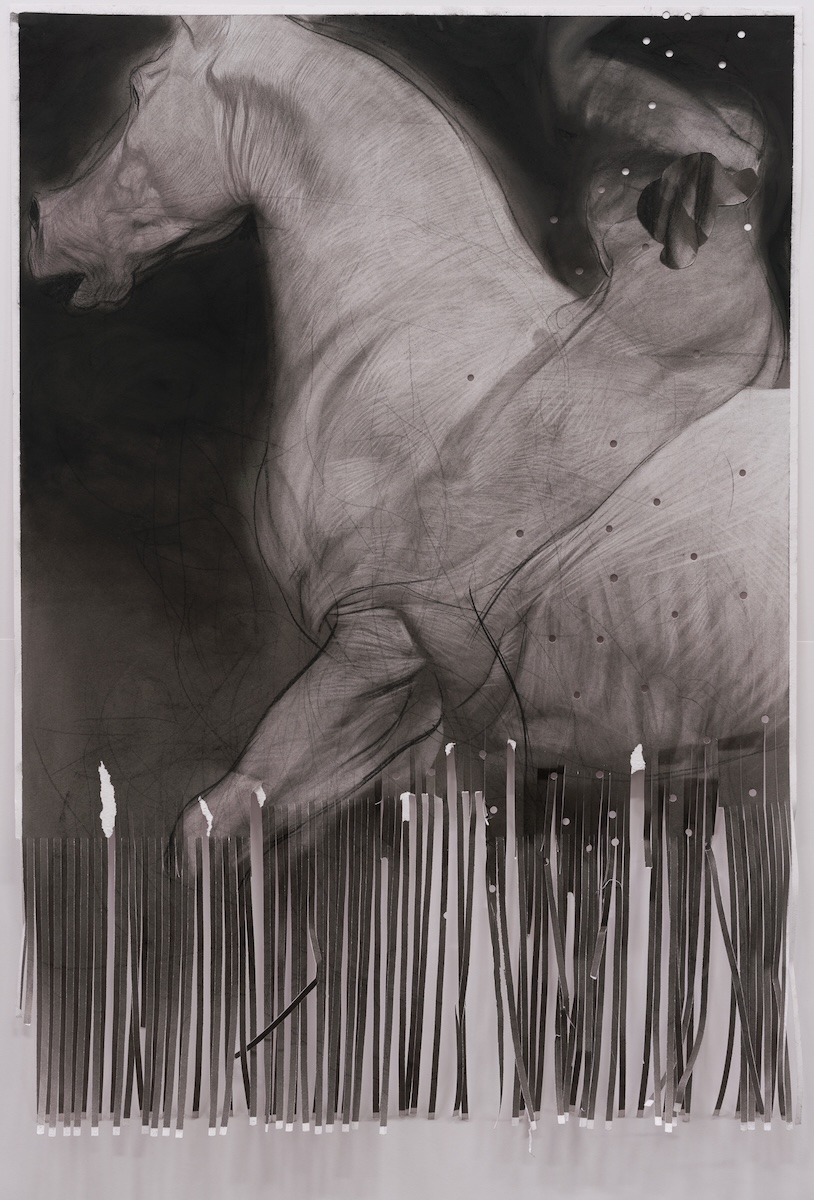
The Advant Garde 2018 Kohle auf Papier 100 x 70 cm 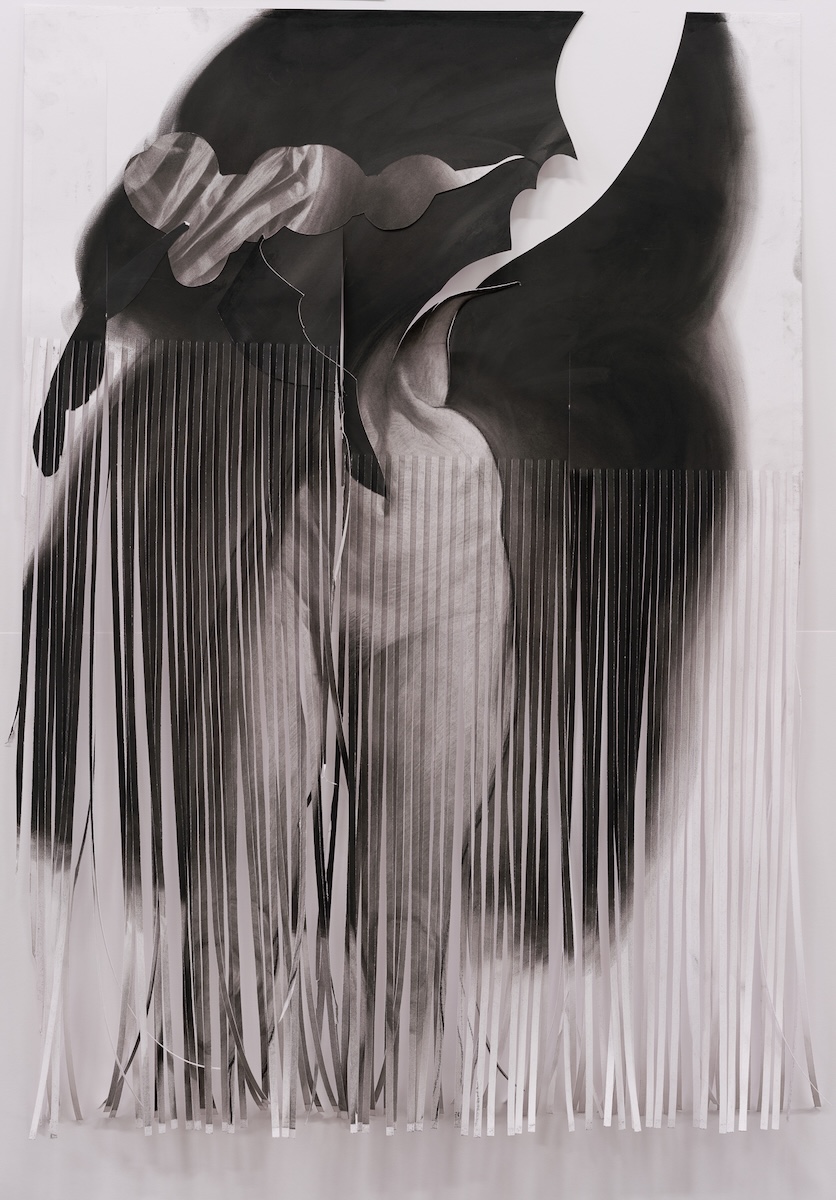
The Old Fashioned 2018 Kohle auf Papier 100 x 70 cm 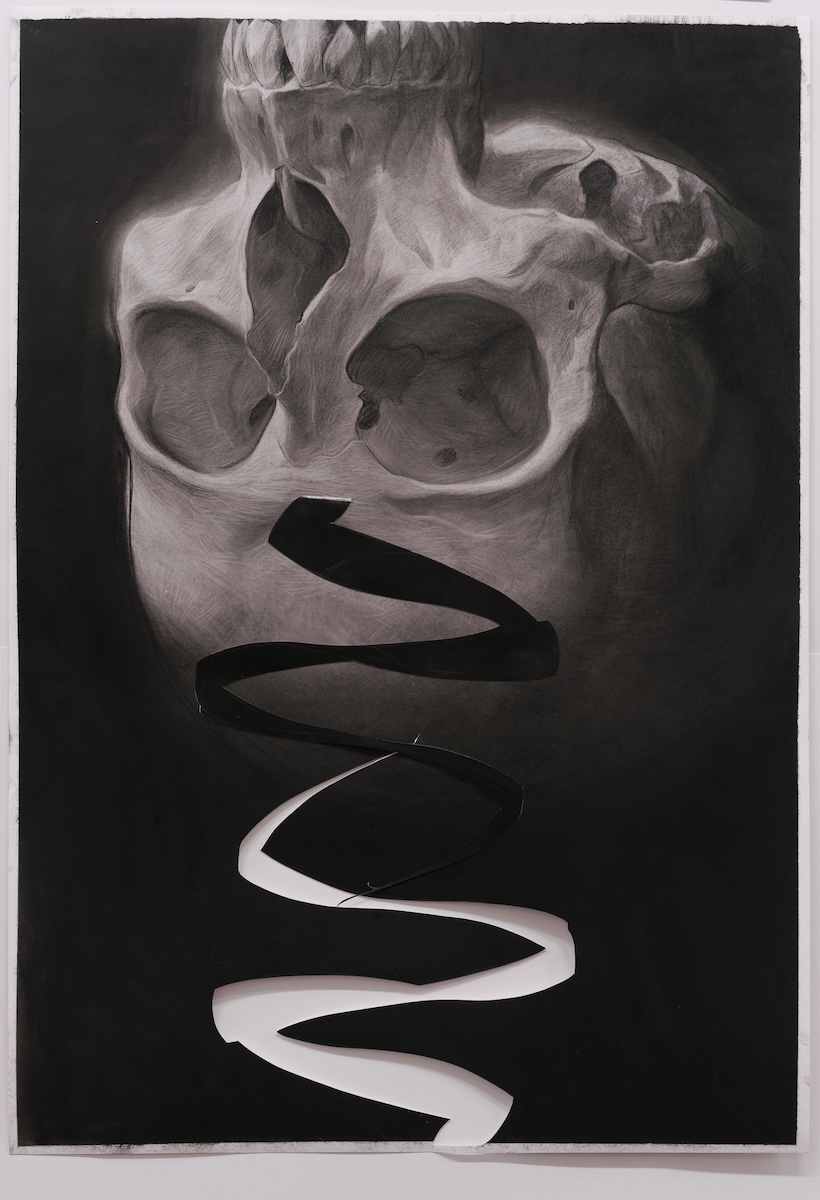
Der Code 2018 Kohle auf Papier 100 x 70 cm 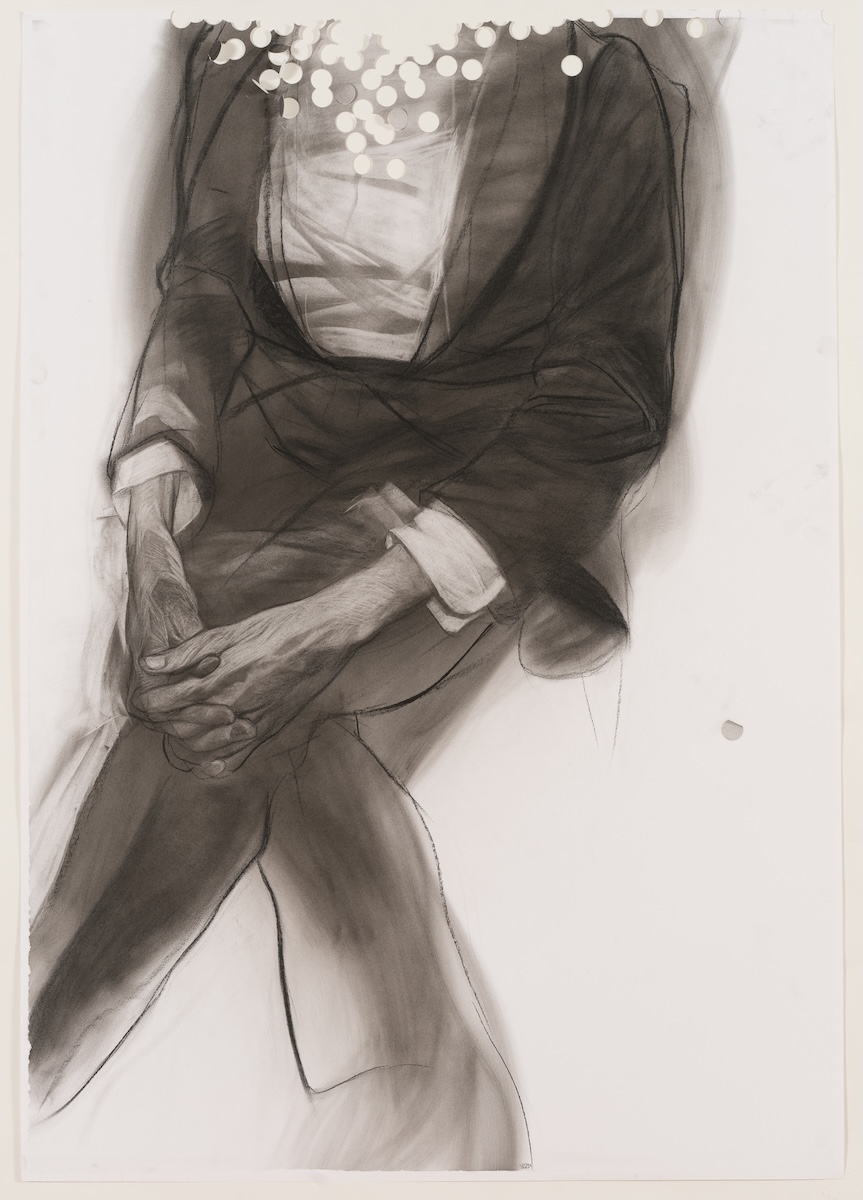
Rüstung 2018 Kohle auf Papier 100 x 70 cm