
Smaïl Kanouté
Alexandra Etienne – Cœur à cœur
Introducing…
Smail Kanouté
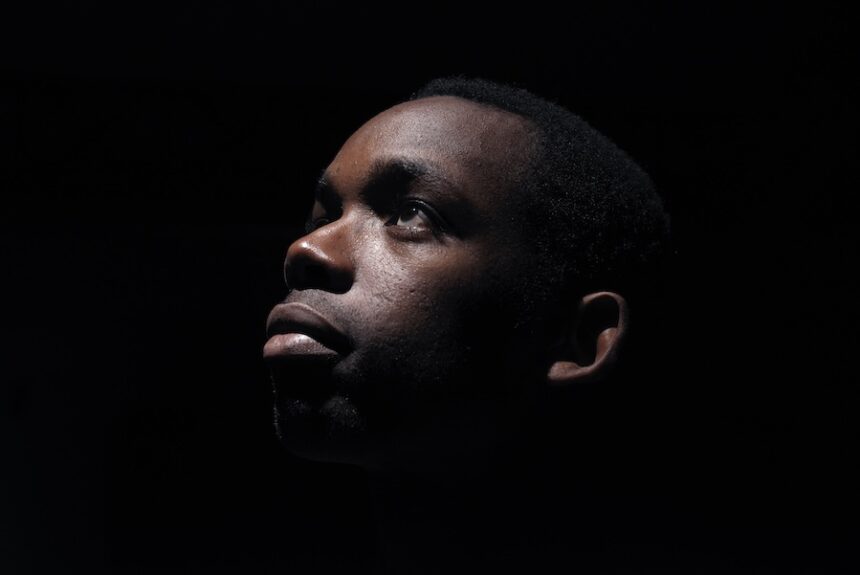
Smail Kanoute’s work is cross-disciplinary and infused with energy and poetry.
Cross-disciplinary: hybrid and eclectic. Smail connects disciplines and techniques in unexpected ways , weaves together textiles with serigraphy; tech with dance. In his Afro Ninpo series for instance, each print mixes styles and motifs from Japan, Australia, South Africa and Mali for us to seek and find resonances between seemingly distinct cultures.
Energy as in a dance, where the body morphs into something new from one project to the next. Each brushstroke is like a spark of electricity in Jidust; or a rhythmic screen print in DancInk. Movement describes an aerial script that can be read like a palimpsest, a text with multiple layers.
Poetry underscores his reflexive and lyrical performances: in Les Actes du Desert for instance, sand is interspersed with dance and voice recordings from his trips to Mali to reflect on spiritual ancestry -attuned to the Malian saying that “dust retains the memory of ancestors”. Grains of sand slip through his fingers like specks of life. Requiem is an ode to the whirling dervishes’ gestures and to the royal history of the Saint Denis Basilica in Paris. Both are tokens of ritual and of lineage.
Now for this first interview with Smail, a couple of questions to find out more…
1 Is there a particular artwork/person/place/situation that inspired/motivated you to become an artist?
I choose the land because for me it represents the roots. We are made of matter, particles and dust. The earth evolves like life and everything is ephemeral like a gesture, an image, an odor, a moment, a sound, an emotion. The earth is where I feel best. The dust is in perpetual motion.
2 Is there a particular artwork/person/place/situation that inspired/motivated you to become an artist?
Yes, Christine Lehot is the one who motivated me to become an artist. She helped me overcome my stuttering by teaching me breathing techniques to speak in front of an audience. She pushed me to pass the competitions of Arts Deco and the Fine Arts School in Paris. She trained me in drawing, painting, self-confidence and optimism. She always said to me: ”Everything is possible” …
3 Do you consider yourself spiritual and how does this feed into your work?
I am spiritual in the sense that when I paint or draw I meditate. I love to create during Ramadan because that’s where I get all my inspiration. I go to the essential. I’m interested in dancing whirling dervishes which is beautiful because the more you shoot, the more you feel centred and connected to the universe. At that moment we feel alive in the present. All that I do in my work is a universal language that can speak to anyone and adapt to any interpretation. I try to make visible the invisible, whether in dance or graphic design.
4 Is there a type of music/book/author in general that stimulates you?
I love “The Alchemist” by Paulo Coelho, and Amadou Hampâté Bâ’s stories. Music stimulates me as well, in particularly the kora instrument of West Africa which connects me to my ancestors.
5. Please tell us what your are currently working on and what you are looking forward to this year in terms of exhibitions/shows/events (can be both, your own or other artists)
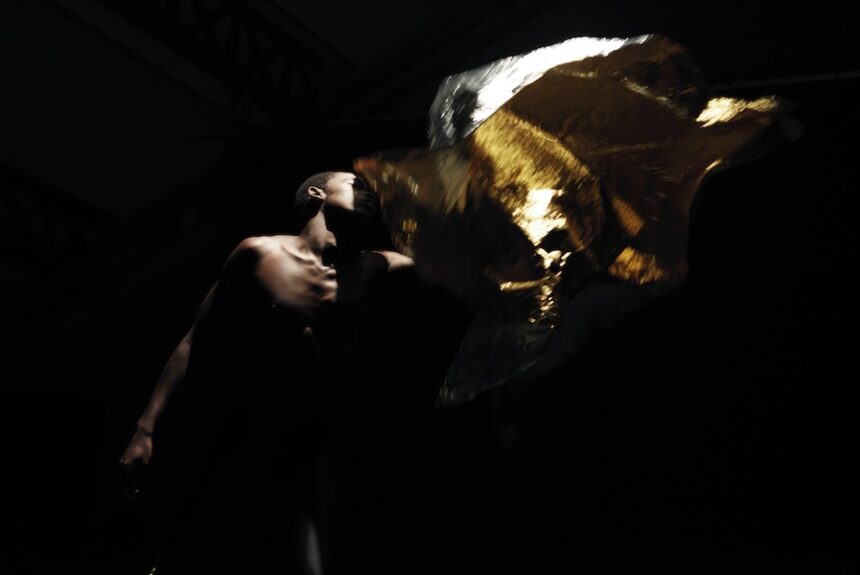
On the live show side, in ‘Jidust’ (Dust of Water) my body dances like a brush, drawing in space ephemeral lines. I am both a dancer, graphic artist, almost ‘choreographer-graffiti’, and I compose a watery and luminous solo by delivering a melee with the interactive wall developed by the designer artist Antonin Fourneau. This wall, Waterlight Graffiti, consisting of thousands of LEDs, lights up when touched by water. At the meeting of this technology, dance is invented fluid, whirling and supple, and the speed of light becomes the thread of the dancer’s existence. Filigree are outlined moments, energies that are expressed in soft light at the edge of the parietal art, as brilliant as sensual.
Graphic design side, I collaborated with PANAFRICA SHOES on two models of shoes that they named Mopti and Gao because my origins are Malian. I realized the patterns of the fabric and I’m proud of this collaboration.
On the exhibition side, I will be exhibiting on July 16th with the association Art For Humans at the Bar à Bulles in Pigalle on the theme of the approach for humanitarian associations.
6. What do new technologies represent for you as a dancer and choreographer?
New technologies are for me interlocutors, in the sense that I want to dialogue with them to make visible the invisible. I am sensitive to graphics and for me technology can make a thought, a breath, a gesture, these open to other types of dreams and at the same time we refer to the human.
7. For Jidust in particular, you mentioned the notion of ‘breath’ which also recalls language, and therefore writing .. could you tell us more about other works / projects to come?
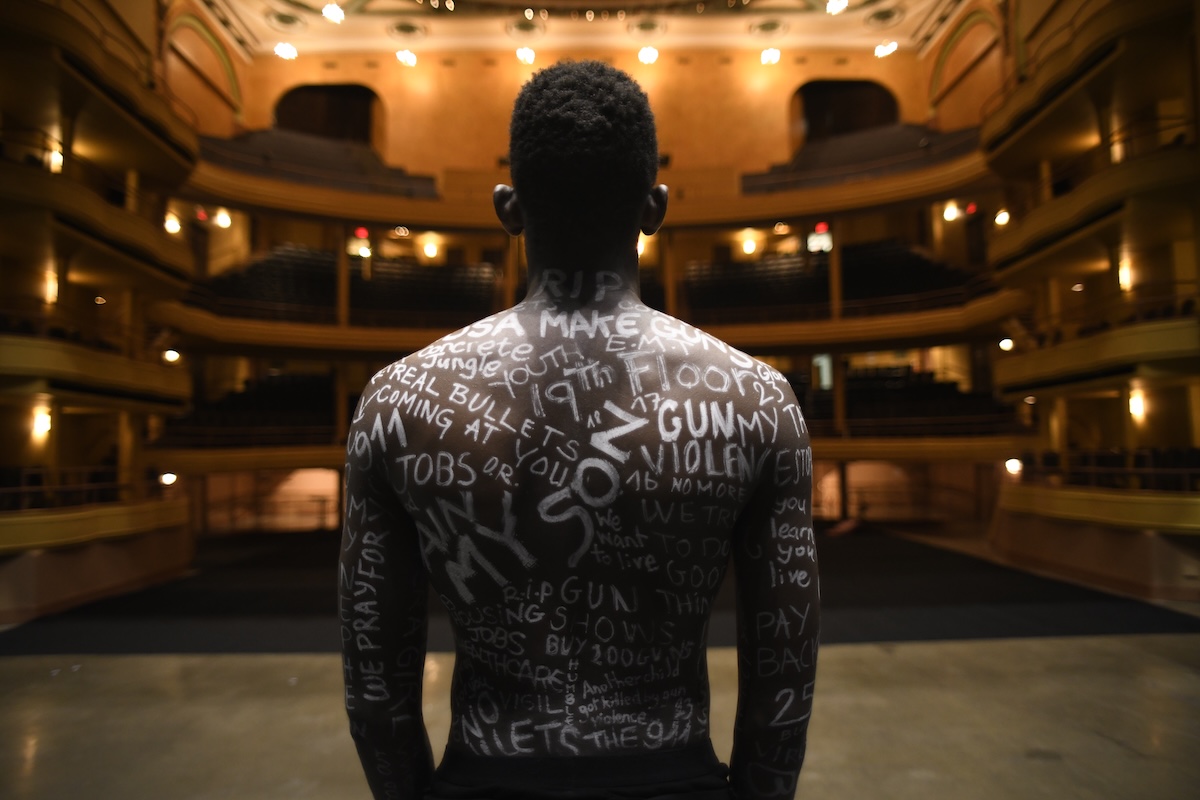
Yes my next creation ‘Never Twenty One’ is based on gun violence. I will explore the tracks that words, memories and absence can leave on the body. The trio of dancers will enter into dialogue with gestures, words and speech. So yes I continue this work on language. In parallel, a triptych of videos will allow different cultures and languages to meet and communicate with each other: in NYC with dance and words, in Tokyo with Afro-Asian dance and mixing and in Benin with dance and dance. voodoo music. Language is an integral part of my job.
8. The Afro-Ninpo series incorporates motifs from different cultures. This plurality emphasizes that of your choreographic approach, always versatile … dance for you is a dialogue with …?
Dance is a dialogue with time. I work on the present, the past and the future, as well as afro-futurism. When I dance I dialogue with space-time because my idea is to cross different memories or atmospheres that I lived in Rio, Paris, Bamako to bring them together on stage and make them coincide with visible or invisible elements.
It is a perpetual dialogue between dance, visual and digital arts because each element is dependent on others. At the source of any choreography or painting I reflect on the same elements that constitute them: the line, the curve, the color, the rhythm, the emotion.